
Case Study — Urban Analytics
Case Study — Urban Analytics
Gensler City Infrastructure Analysis
Gensler City Infrastructure Analysis
What does it take to turn fragmented city datasets into an evidence-based narrative that moves decision-makers from passive review to strategic action?
What does it take to turn fragmented city datasets into an evidence-based narrative that moves decision-makers from passive review to strategic action?
Role
Role
Research | Strategy | Data Storytelling
Research | Strategy | Data Storytelling
Duration
Duration
3 Months
3 Months
Industry
Industry
Urban Design / Analytics
Urban Design / Analytics
✦ Collaborative project. Spatial analysis and ArcGIS work by Zhong Yun and Raja Manickan. Tracy Zheng co-led research. My contribution focused on strategy, framework design, and data storytelling.
✦ Collaborative project. Spatial analysis and ArcGIS work by Zhong Yun and Raja Manickan. Tracy Zheng co-led research. My contribution focused on strategy, framework design, and data storytelling.
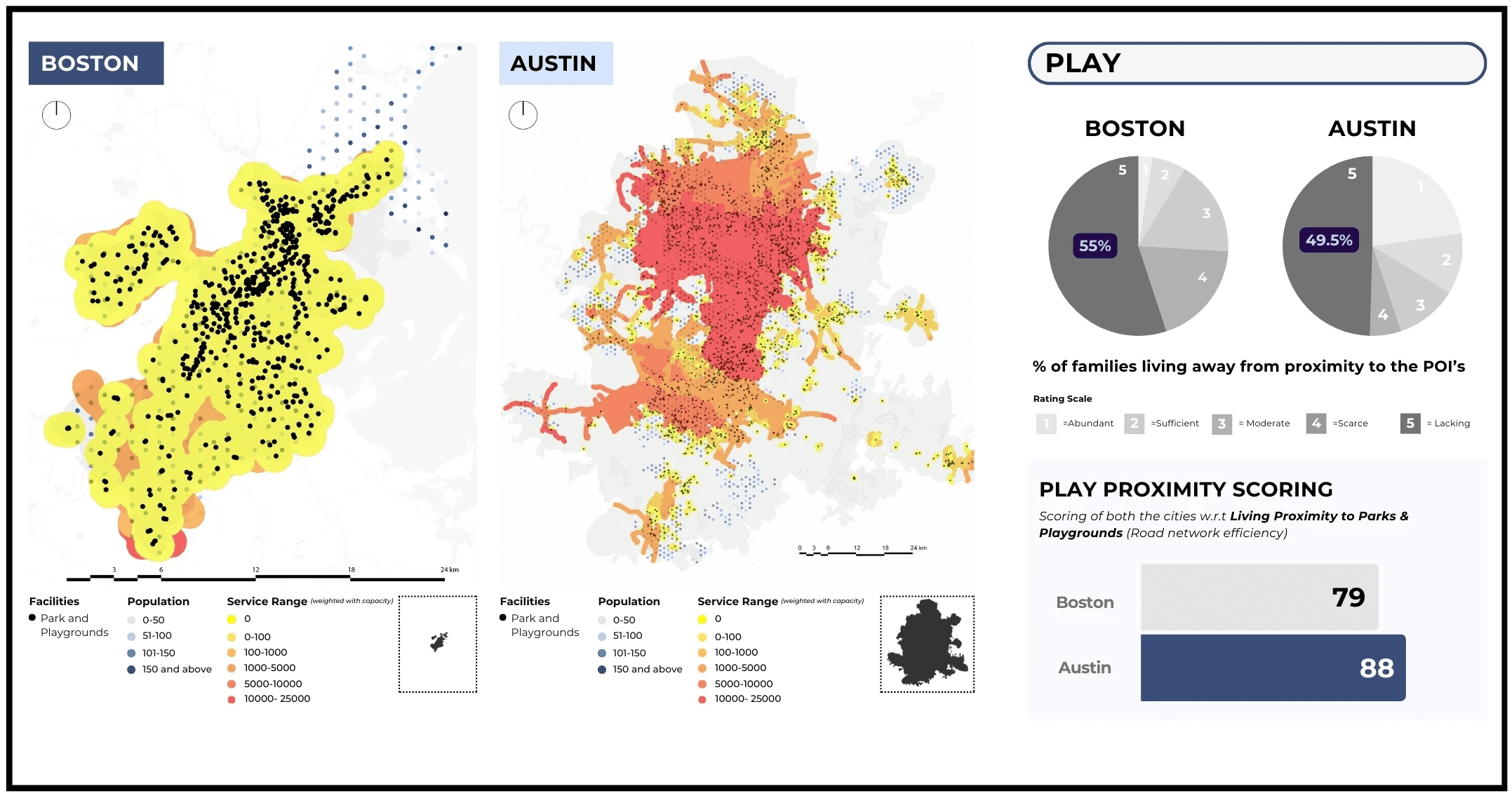
Final Dashboard VIsual for Move Dimension
Final Dashboard VIsual for Move Dimension
6
6
Urban dimensions unified into a single comparative scoring framework
Urban dimensions unified into a single comparative scoring framework
2
2
Cities: Boston and Austin, compared across spatial equity and civic experience
Cities: Boston and Austin, compared across spatial equity and civic experience
75→5
75→5
Slides condensed to a 5-minute leadership pitch without losing strategic depth
Slides condensed to a 5-minute leadership pitch without losing strategic depth
Framework piloted as the launchpad for Gensler's broader Cities Research methodology
Framework piloted as the launchpad for Gensler's broader Cities Research methodology
01 - CONTEXT
01 - CONTEXT
The data existed.
The story didn't.
The data existed.
The story didn't.
Urban practitioners working on equity and accessibility face a familiar problem: datasets exist, but they're fragmented, non-standardized, and siloed across disciplines. Without a cohesive framework, policymakers and designers default to optimizing for aesthetic upgrades over systemic wellbeing.
On Gensler's Cities Research Team, my role was to co-develop a cross-city comparative scoring framework, connecting spatial equity, infrastructure access, and civic experience into a single, actionable narrative.
Urban practitioners working on equity and accessibility face a familiar problem: datasets exist, but they're fragmented, non-standardized, and siloed across disciplines. Without a cohesive framework, policymakers and designers default to optimizing for aesthetic upgrades over systemic wellbeing.
On Gensler's Cities Research Team, my role was to co-develop a cross-city comparative scoring framework, connecting spatial equity, infrastructure access, and civic experience into a single, actionable narrative.
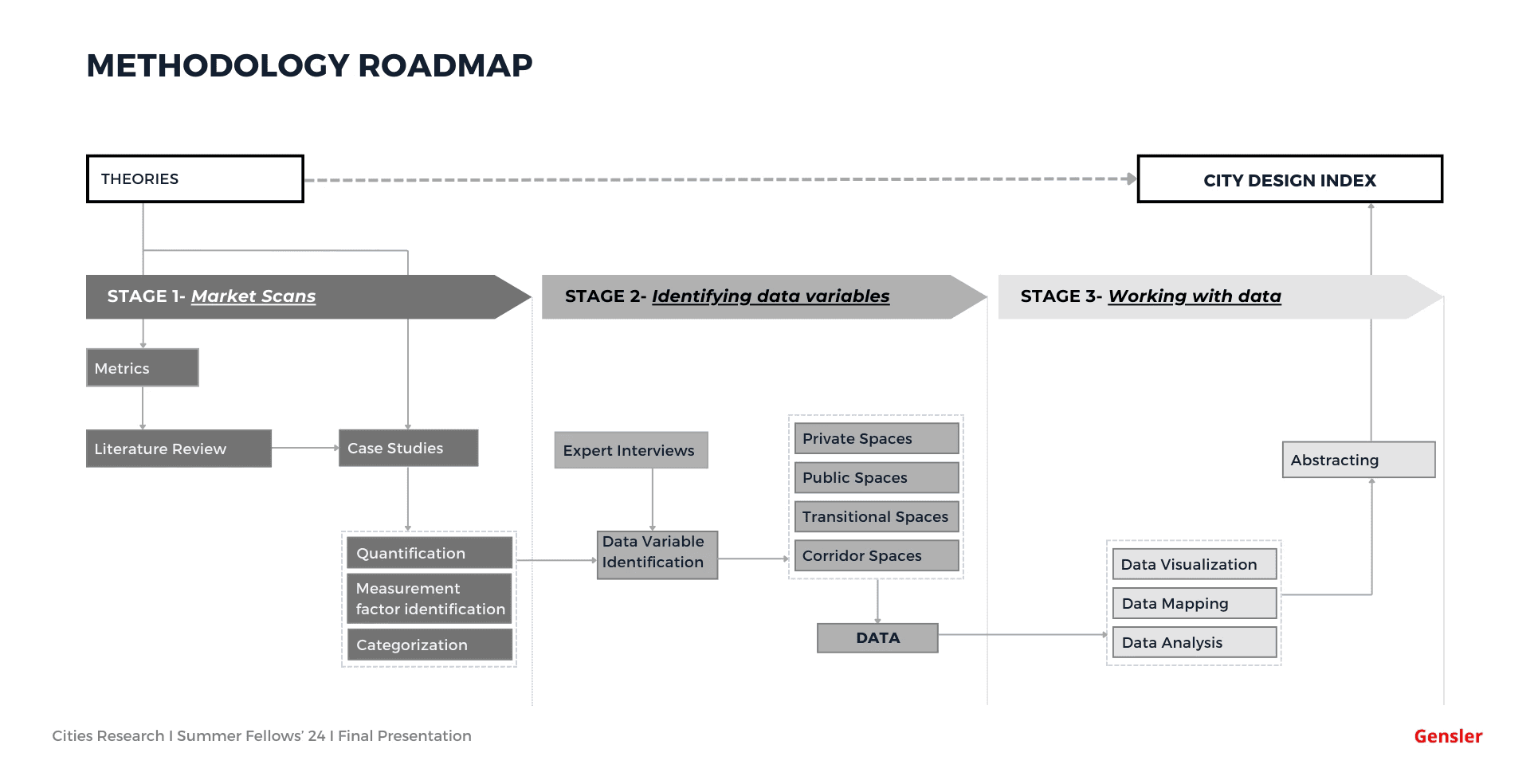
Multi-phase methodology roadmap
Multi-phase methodology roadmap
02 - RESEARCH
02 - RESEARCH
How do you build a common language from six cities' worth of conflicting datasets?
How do you build a common language from six cities' worth of conflicting datasets?
Literature review to identify key equity metrics across six dimensions of urban wellbeing, followed by
Qualitative coding of academic and policy materials to surface what cities measure and what they systematically ignore.
GIS data collection of the six dimensions
Prioritization (2 x 2 matrix) to understand which 2 cities to pilot based on availability of data and time
Cross-team synthesis was as much the method as any single too
GIS spatial analysis and synthesis using Rstudio
Aligning GIS spatial analysis with human-centered storytelling required constant translation between disciplines that rarely shared a vocabulary.
Literature review to identify key equity metrics across six dimensions of urban wellbeing, followed by
Qualitative coding of academic and policy materials to surface what cities measure and what they systematically ignore.
GIS data collection of the six dimensions
Prioritization (2 x 2 matrix) to understand which 2 cities to pilot based on availability of data and time
Cross-team synthesis was as much the method as any single too
GIS spatial analysis and synthesis using Rstudio
Aligning GIS spatial analysis with human-centered storytelling required constant translation between disciplines that rarely shared a vocabulary.
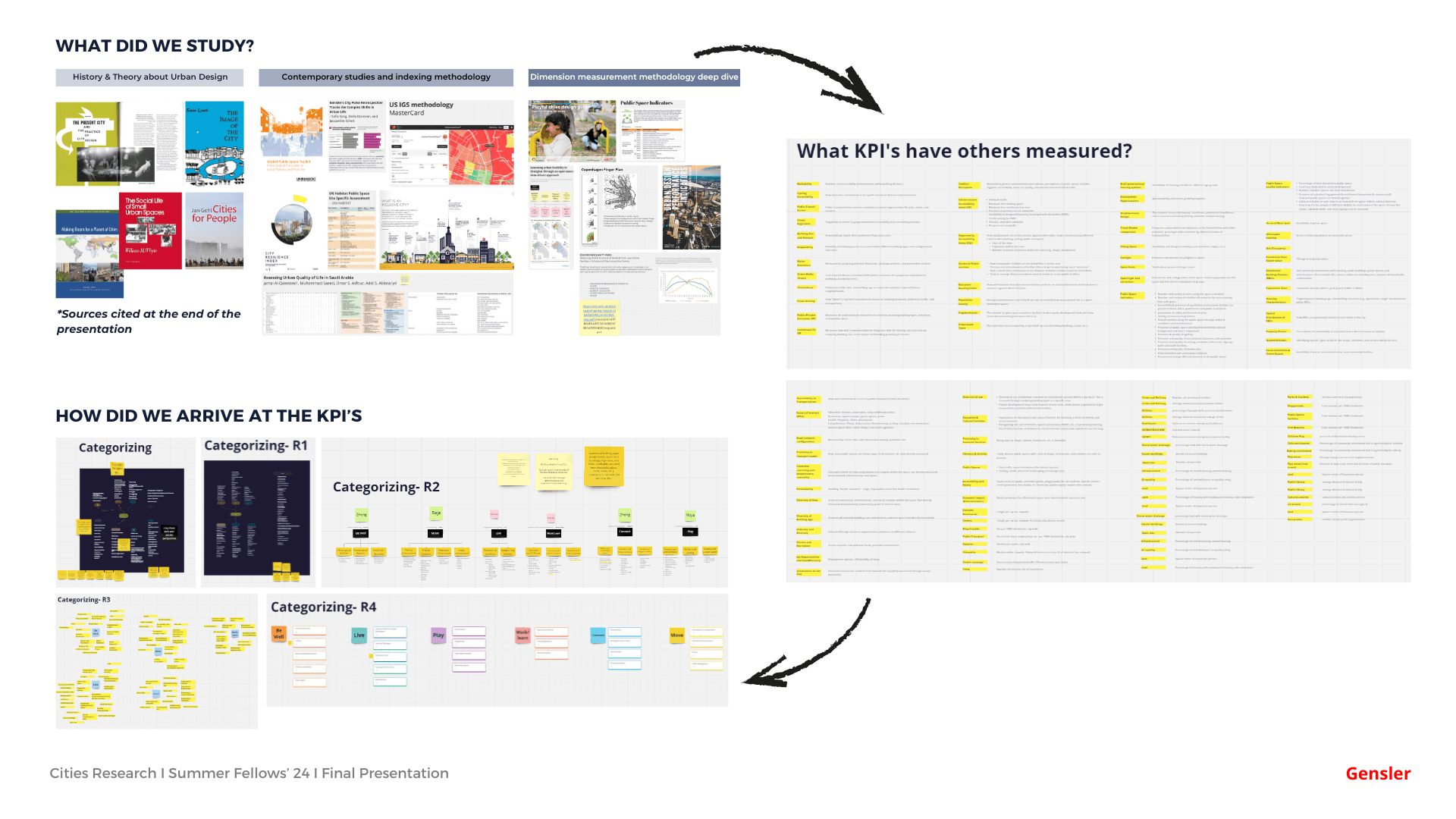
Methodology showing how we arrived at defining the KPI's
Methodology showing how we arrived at defining the KPI's
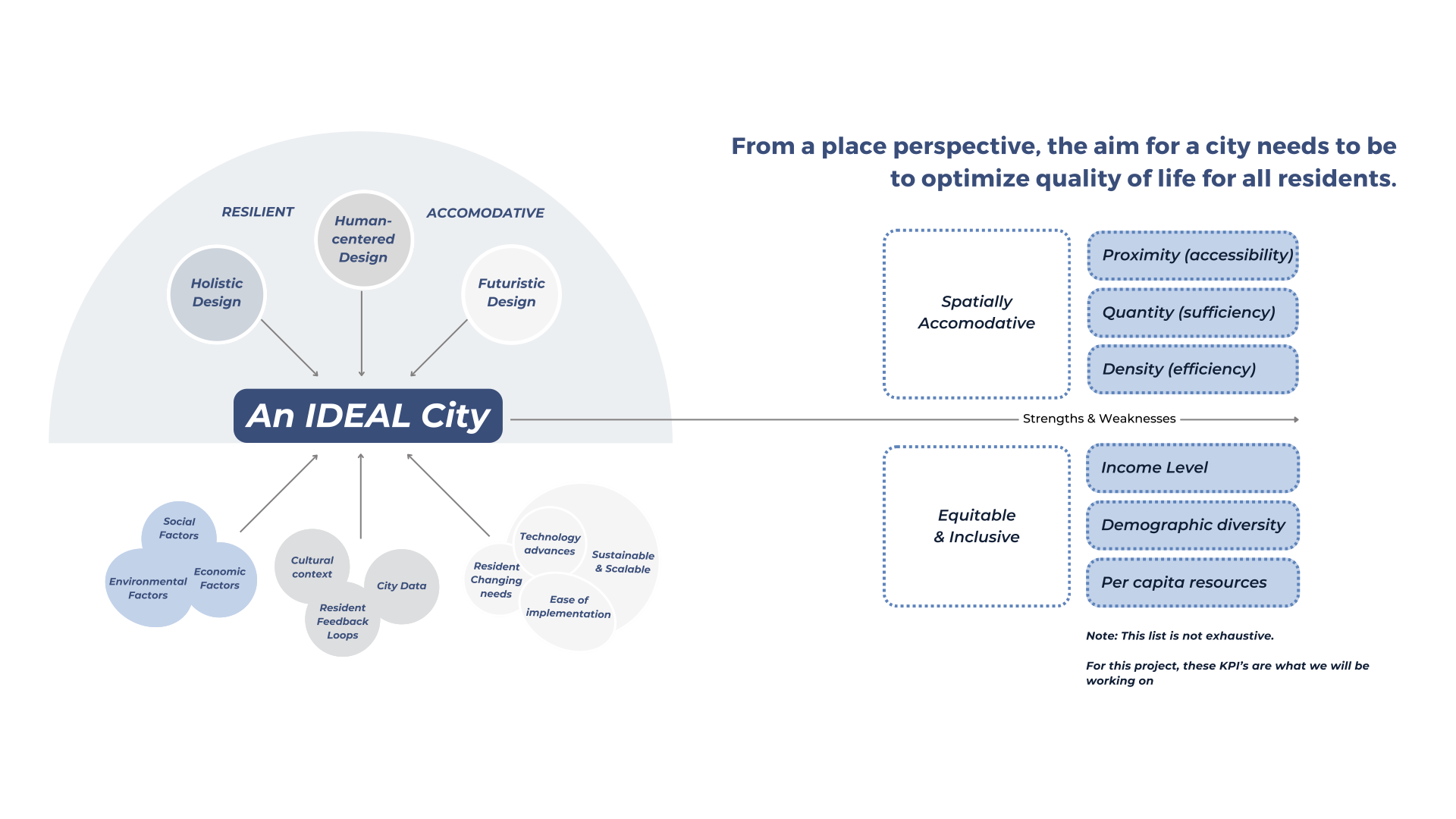
Ideal City Framework
Ideal City Framework
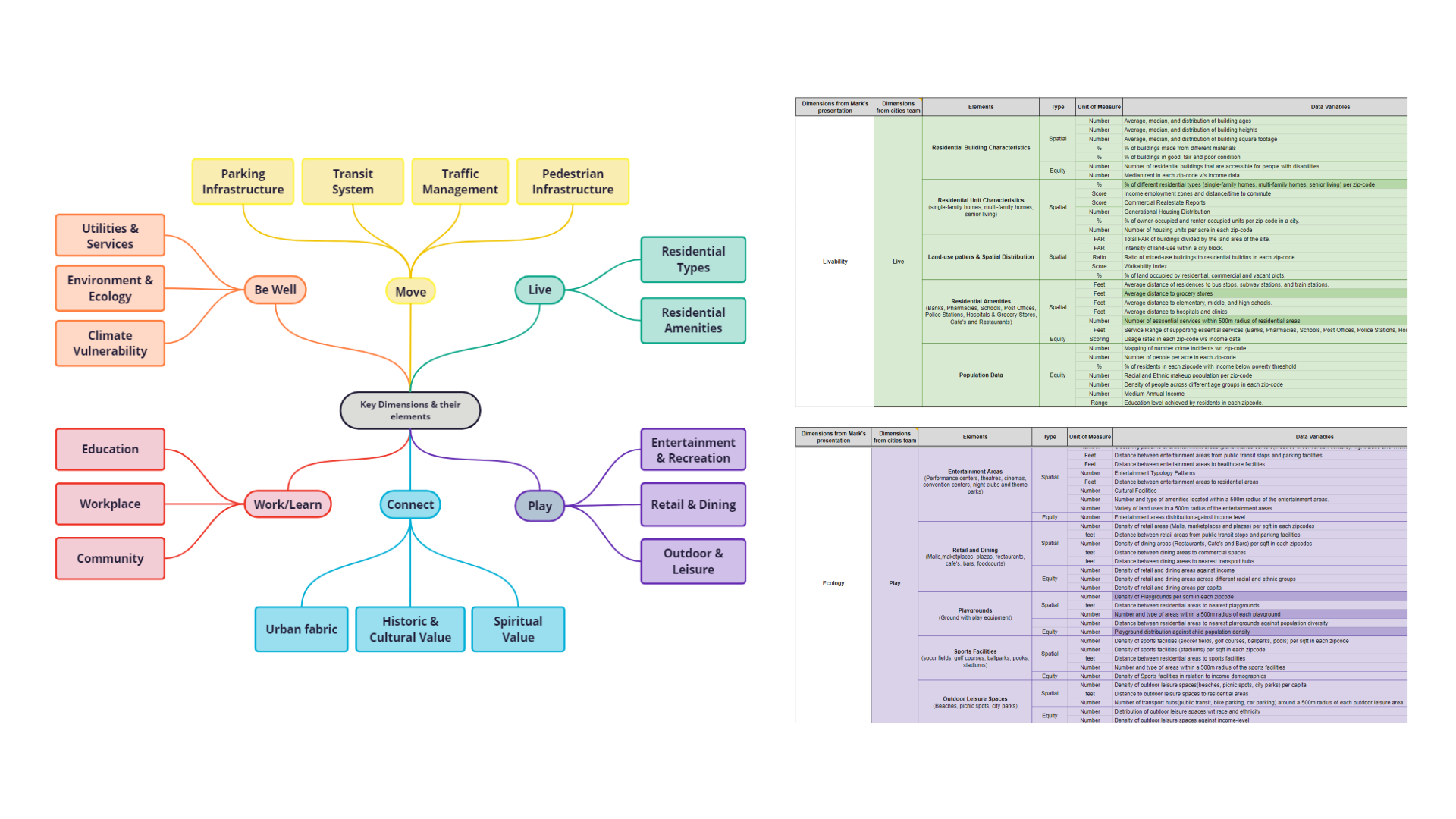
KPI Identification Framework
KPI Identification Framework
03 - INSIGHTS
03 - INSIGHTS
What does the data reveal when you stop treating cities as infrastructure problems?
What does the data reveal when you stop treating cities as infrastructure problems?
01
01
Design ≠ Equity.
Design ≠ Equity.
Cities consistently optimize for lifestyle aesthetics and landmark infrastructure over systemic wellbeing. The gap between what gets measured and what gets built reveals the actual priority hierarchy.
Cities consistently optimize for lifestyle aesthetics and landmark infrastructure over systemic wellbeing. The gap between what gets measured and what gets built reveals the actual priority hierarchy.
02
02
Metrics are co-dependent.
Metrics are co-dependent.
Mobility, play, and wellness don't operate in isolation. A deficit in one dimension compounds across others. Single-metric dashboards obscure the systemic nature of urban inequality.
Mobility, play, and wellness don't operate in isolation. A deficit in one dimension compounds across others. Single-metric dashboards obscure the systemic nature of urban inequality.
03
03
Simplicity builds buy-in.
Simplicity builds buy-in.
Stakeholders consistently preferred clear, relatable visualizations over complex data graphics, even when the complex version was more statistically complete. Clarity is a design constraint, not a compromise.
Stakeholders consistently preferred clear, relatable visualizations over complex data graphics, even when the complex version was more statistically complete. Clarity is a design constraint, not a compromise.
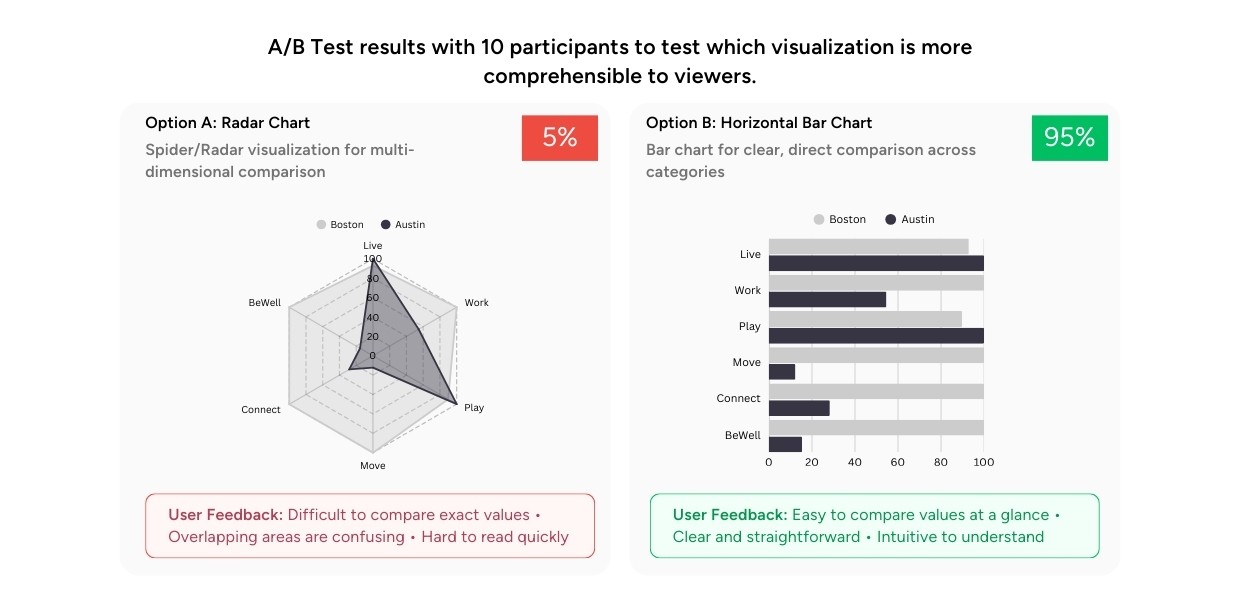
A/B test results showing users/viewers preferred simplified and direct visualizations over complex ones.
A/B test results showing users/viewers preferred simplified and direct visualizations over complex ones.
04 - STRATEGY
04 - STRATEGY
What shifts when a city score becomes a strategy signal instead of a ranking?
What shifts when a city score becomes a strategy signal instead of a ranking?
From
From
Abstract infrastructure metrics, detached from lived experience
Abstract infrastructure metrics, detached from lived experience
To
To
A human-centered question: "How do citizens actually engage with their city?" reframing urban health as proximity and experience
A human-centered question: "How do citizens actually engage with their city?" reframing urban health as proximity and experience
From
From
City rankings that declare winners and losers
City rankings that declare winners and losers
To
To
Dimension scores that reveal focus areas — where infrastructure lags or exceeds expectations relative to population need
Dimension scores that reveal focus areas — where infrastructure lags or exceeds expectations relative to population need
From
From
Cross-team tension between GIS analysts and designers
Cross-team tension between GIS analysts and designers
To
To
Shared language forged through rapid A/B visualization testing, resolving disciplinary disagreements through direct stakeholder feedback
Shared language forged through rapid A/B visualization testing, resolving disciplinary disagreements through direct stakeholder feedback
From
From
A 75-slide comprehensive analysis report
A 75-slide comprehensive analysis report
To
To
A 5-minute leadership pitch, the purpose isn't to inform, it's to persuade. Analysis earns the room; narrative moves it
A 5-minute leadership pitch, the purpose isn't to inform, it's to persuade. Analysis earns the room; narrative moves it
05 - SOLUTION
05 - SOLUTION
What does the City Design Index actually make possible?
What does the City Design Index actually make possible?
A cross-city comparative framework built around the six dimensions, supported by PowerBI dashboards, ArcGIS proximity mapping, and an Urban Proximity Score that connects design decisions directly to citizen experience across Boston and Austin.
A cross-city comparative framework built around the six dimensions, supported by PowerBI dashboards, ArcGIS proximity mapping, and an Urban Proximity Score that connects design decisions directly to citizen experience across Boston and Austin.
Layer 01
Urban Proximity Score
Urban Proximity Score
A standardized metric measuring each resident's spatial relationship to points of interest within each dimension, transit hubs, healthcare facilities, green space, employment centers. Translates GIS data into a single number stakeholders can act on.
A standardized metric measuring each resident's spatial relationship to points of interest within each dimension, transit hubs, healthcare facilities, green space, employment centers. Translates GIS data into a single number stakeholders can act on.
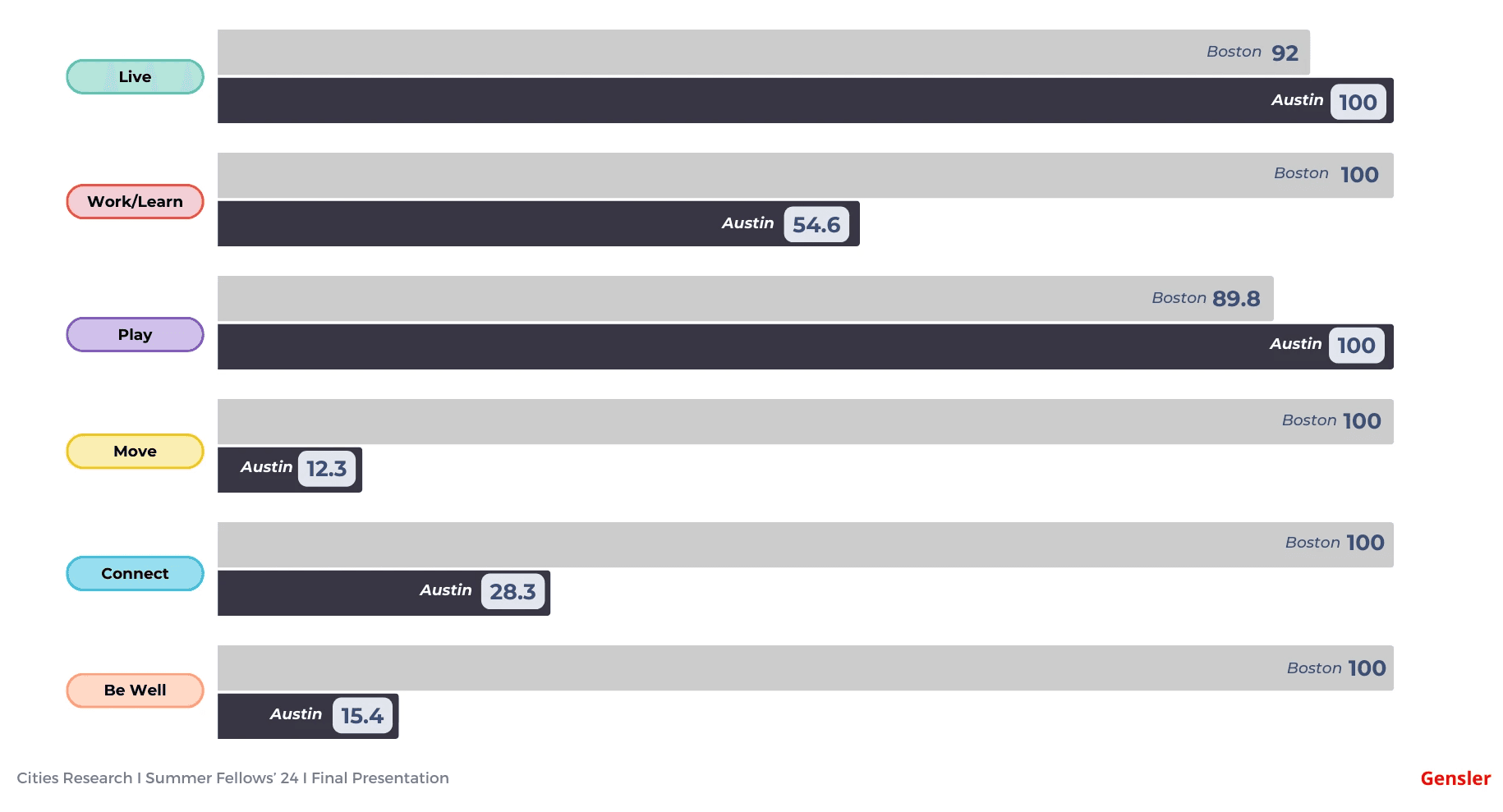
Scoring comparison of Boston and Austin across the six urban dimensions (Live, work, play, move, connect and be well).
Scoring comparison of Boston and Austin across the six urban dimensions (Live, work, play, move, connect and be well).
Layer 02
Dimension Dashboards
Dimension Dashboards
PowerBI and ArcGIS dashboards for each of the six dimensions, built for Boston and Austin. POI locations overlaid on population parcels with road network efficiency scoring designed to be interpretable by both GIS analysts and non-technical leadership.
PowerBI and ArcGIS dashboards for each of the six dimensions, built for Boston and Austin. POI locations overlaid on population parcels with road network efficiency scoring designed to be interpretable by both GIS analysts and non-technical leadership.
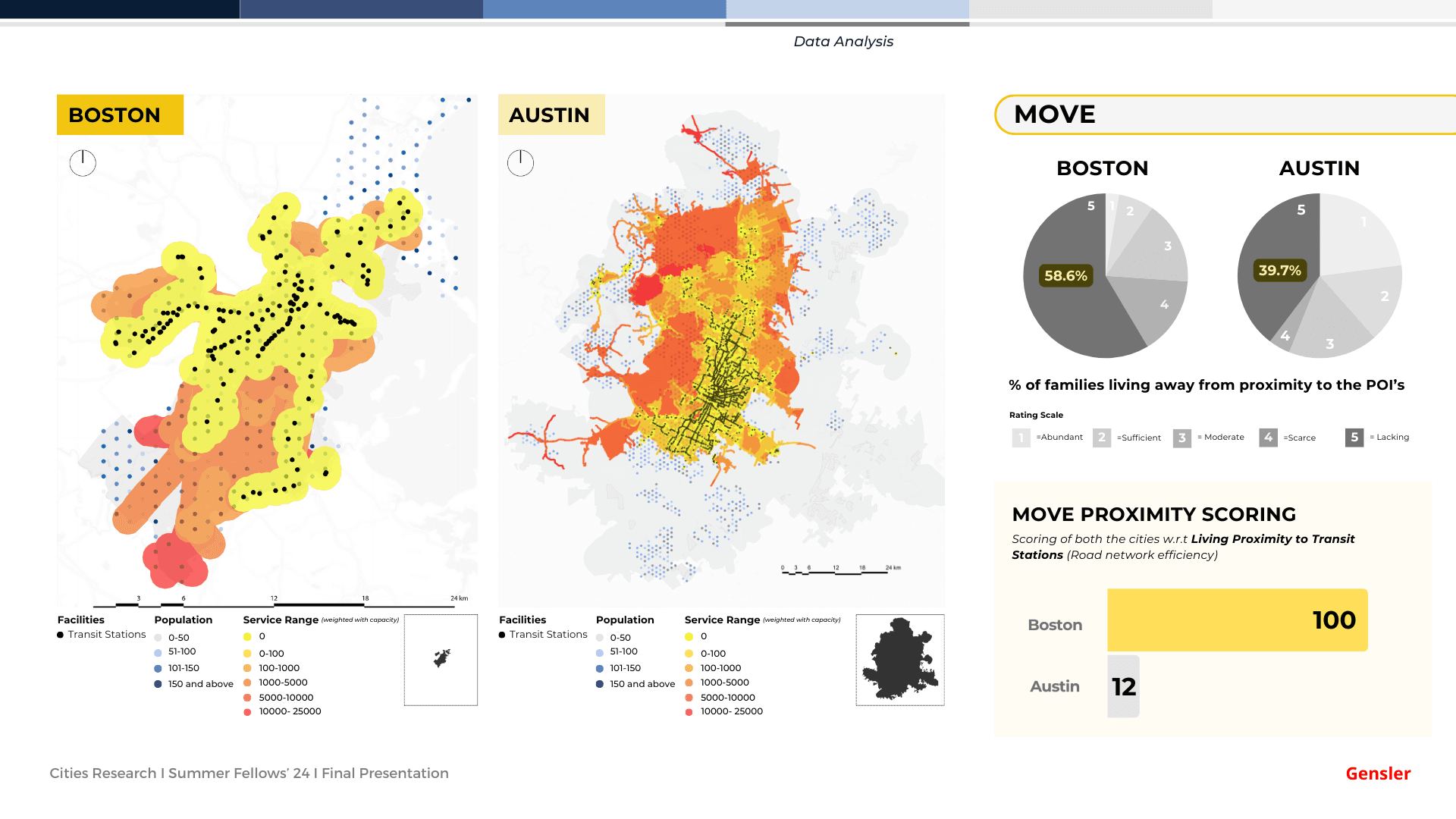
Dashboard for the dimension- MOVE (The connection each person has to the city's POI-transit stations in a city). Maps show the Point of Interest (POI) locations overlayed on population parcels and evaluating road network efficiency to measure service quality and accessibility for the population served.
Dashboard for the dimension- Connect (The connection one has to a city's POI-historic landmarks and monuments). Maps show the Point of Interest (POI) locations overlayed on population parcels and evaluating road network efficiency to measure service quality and accessibility for the population served. ArcGIS maps by Zhong Yun and Raja Manickan
Layer 03
The Correlation Matrix
The Correlation Matrix
A visualization showing the interdependence of all six dimensions within each city making visible how a deficit in Move compounds against Be Well, or how Connect scores amplify the impact of Live. The research finding that changed how the team communicated the index.
A visualization showing the interdependence of all six dimensions within each city making visible how a deficit in Move compounds against Be Well, or how Connect scores amplify the impact of Live. The research finding that changed how the team communicated the index.
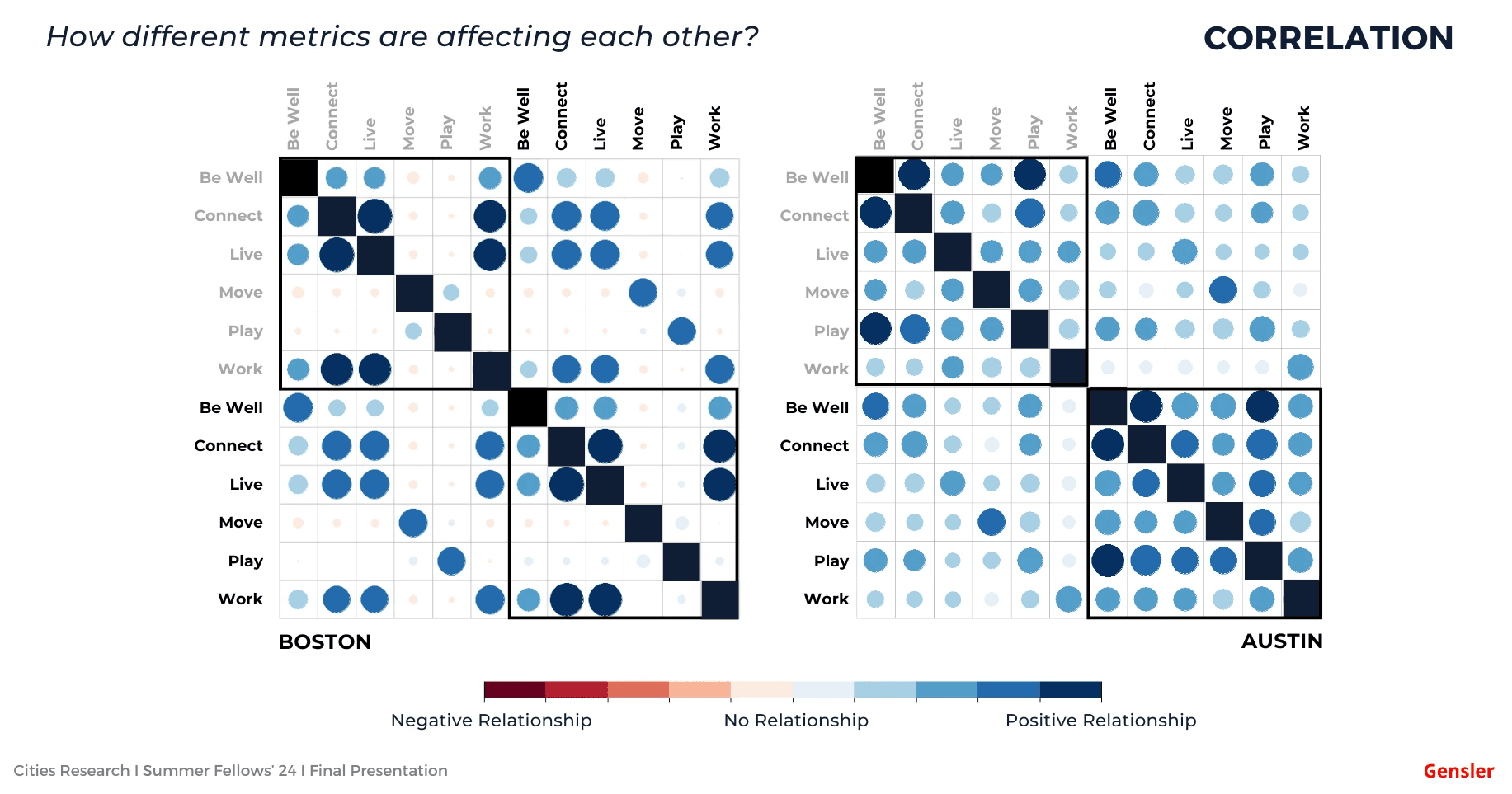
Correlation matrix showing interdependence of the six dimensions within each city
Correlation matrix showing interdependence of the six dimensions within each city
Layer 04
Layered Storytelling Assets
Layered Storytelling Assets
Three parallel outputs for three audiences: a 75-page full report for research teams, a 7-page executive summary for senior leadership, and a 5-minute pitch built specifically to persuade not inform. The condensation strategy became its own methodology Gensler adopted going forward.
Three parallel outputs for three audiences: a 75-page full report for research teams, a 7-page executive summary for senior leadership, and a 5-minute pitch built specifically to persuade not inform. The condensation strategy became its own methodology Gensler adopted going forward.
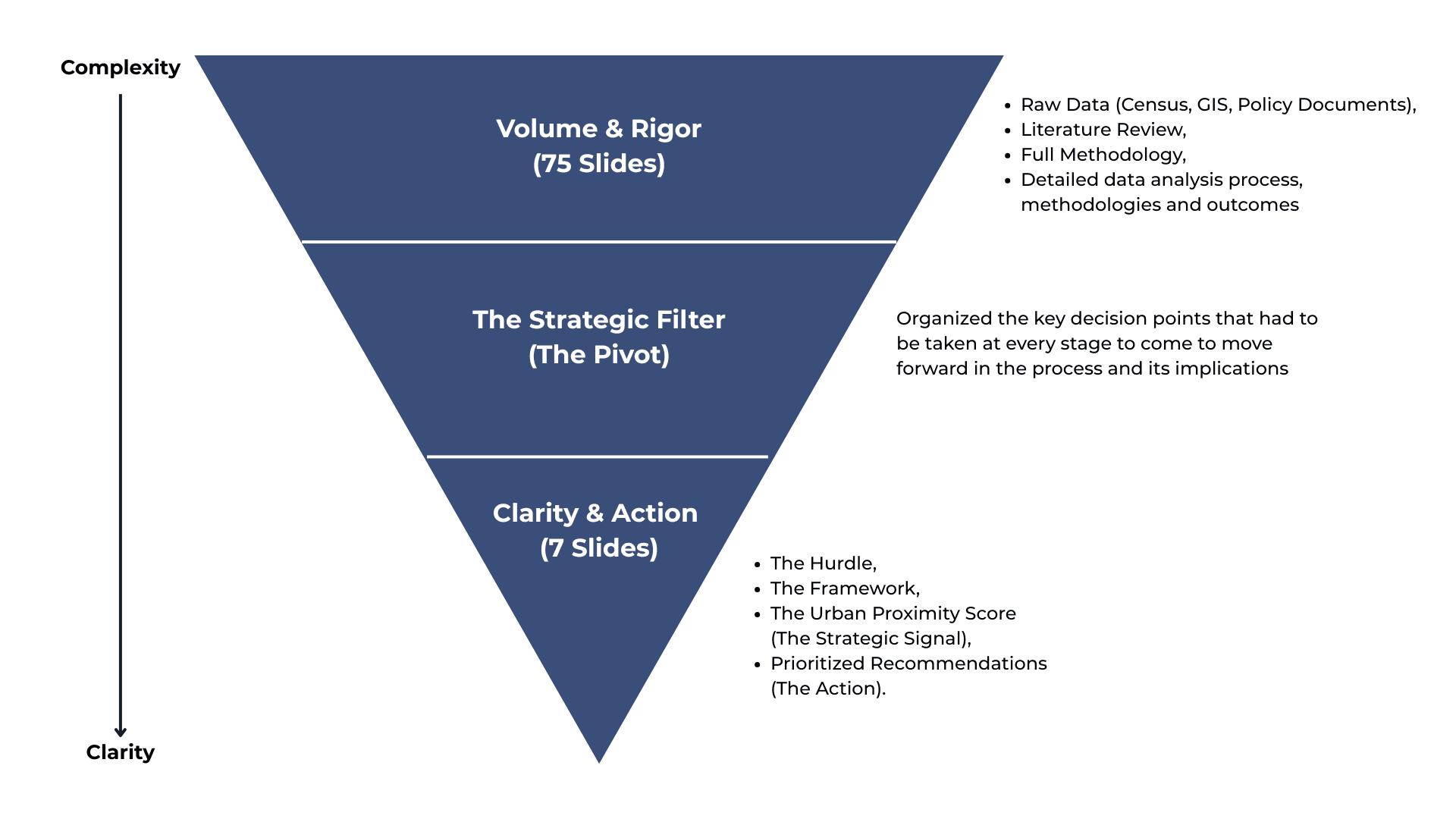
This diagram visualizes the strategic mechanism used to condense the 75-slide comprehensive analysis (Process) into a 7-slide, 5-minute executive pitch (Action). It demonstrates the critical pivot from reporting data rigor to prioritizing the key strategic signals and actionable recommendations needed for stakeholder adoption.
This diagram visualizes the strategic mechanism used to condense the 75-slide comprehensive analysis (Process) into a 7-slide, 5-minute executive pitch (Action). It demonstrates the critical pivot from reporting data rigor to prioritizing the key strategic signals and actionable recommendations needed for stakeholder adoption.
06 - OUTCOMES
06 - OUTCOMES
Did a 3-month framework pilot become organizational infrastructure?
Did a 3-month framework pilot become organizational infrastructure?
The framework didn't just produce deliverables, it changed how the Gensler Cities Research team operates, communicates, and defines quality for future projects.
The framework didn't just produce deliverables, it changed how the Gensler Cities Research team operates, communicates, and defines quality for future projects.
Framework piloted as the launchpad for Gensler's broader Cities Research methodology across future city engagements
Framework piloted as the launchpad for Gensler's broader Cities Research methodology across future city engagements
Urban Proximity Score adopted to connect design decisions directly to citizen experience — a metric that didn't exist before this project
Urban Proximity Score adopted to connect design decisions directly to citizen experience — a metric that didn't exist before this project
Organizational shift — redefined how Gensler's research team communicates complex systems to non-technical audiences
Organizational shift — redefined how Gensler's research team communicates complex systems to non-technical audiences
REFLECTION
REFLECTION
Data alone doesn't inspire change. Data shaped into a story does. Cities needed a mirror not a spreadsheet.
Data alone doesn't inspire change. Data shaped into a story does. Cities needed a mirror not a spreadsheet.
Open to new roles- Seattle & Remote
Looking for research and strategy roles where the insight
actually shapes what gets built, not just validates it after the fact.
Nitya Jois | Seattle WA
Open to new roles- Seattle & Remote
Looking for research and strategy roles where the insight actually shapes what gets built, not just validates it after the fact.
Nitya Jois | Seattle WA
Open to new roles- Seattle & Remote
Looking for research and strategy roles where the insight
actually shapes what gets built, not just validates it after the fact.
Nitya Jois | Seattle WA